Drain Jetting vs Drain Rods: Which Unblocking Method Is More Effective?
High-pressure jetting or traditional drain rods? We compare both methods so you know which drain clearing technique is right for your situation.
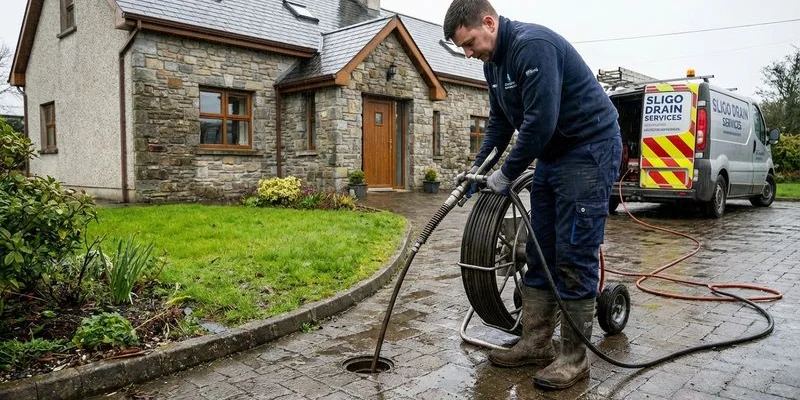
When water starts backing up in your sink or the toilet bowl refuses to drain, the immediate panic is understandable. We know that sinking feeling all too well.
The first question most homeowners ask isn’t about the physics of the pipe but rather, “What is the fastest way to fix this blocked drain?”
Two methods dominate the professional landscape: manual drain rods and high-pressure drain jetting. While both aim to restore flow, our team views them as two completely different tools for two very different jobs. One is a quick fix for a localized clog, while the other is a comprehensive cleaning solution for your entire system.
As a plumbing team clearing drains across County Sligo daily, we want to walk you through exactly how these methods compare. We will look at the costs, the risks to your pipes, and why the “best” method often depends entirely on the age of your home.
What Are Drain Rods?
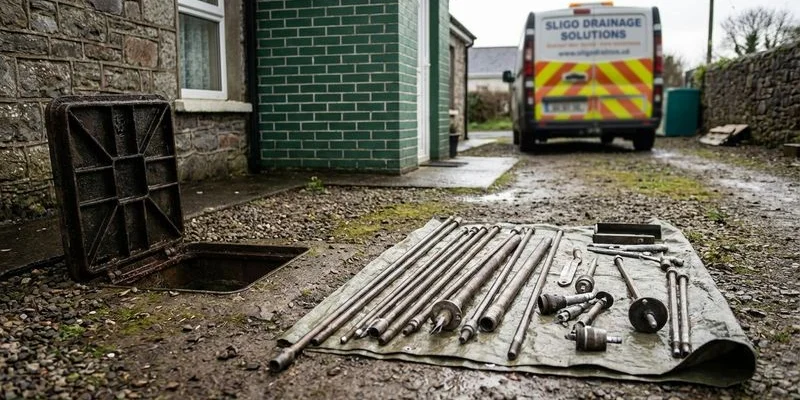
Drain rods are the “first response” tool of the plumbing world. These are typically one-metre flexible polypropylene poles that screw together to form a long shaft.
Our technicians use them to physically push through obstructions. We attach different heads depending on the suspected blockage:
- A plunger head creates pressure to force soft masses like paper to move.
- A corkscrew (worm) attachment twists into rag or root masses to retrieve them.
- A scraper helps remove minor buildup from the pipe edges.
The process is entirely manual. We feed the rods into an inspection chamber or manhole, pushing them until we feel the resistance of the blockage.
Advantages of drain rods
- Cost-effective: This is generally the cheapest professional option. Basic rodding services in Ireland typically range from €80 to €150, making it a budget-friendly first step.
- Immediate deployment: We can start rodding within minutes of arriving without needing heavy machinery or a water supply.
- Ideal for soft blockages: They work perfectly for simple clogs caused by toilet paper, wipes, or kitchen waste located near the access point.
- Silent operation: Rodding is quiet, which is a significant benefit if you need work done late at night in a residential area.
Limitations of drain rods
- The “blind” disadvantage: We cannot see what we are hitting. If the blockage is a collapsed pipe rather than a clog, rods can sometimes make the damage worse.
- Limited reach and power: Manual force drops significantly after 20 metres. Pushing a rod 25 metres down a pipe effectively delivers very little force to the blockage itself.
- Debris remains: Rods punch a hole through the blockage to restore flow, but they do not clean the pipe walls. The sticky residue that caused the clog often stays behind, inviting a new blockage in weeks or months.
- The disconnection risk: This is a classic “insider” danger. If a user twists the rods anti-clockwise (to the left), the threaded joints can unscrew underground. You then have a blockage plus a set of lost rods stuck in your drain.
What Is Drain Jetting?
Drain jetting is effectively a power wash for the inside of your sewer pipes.
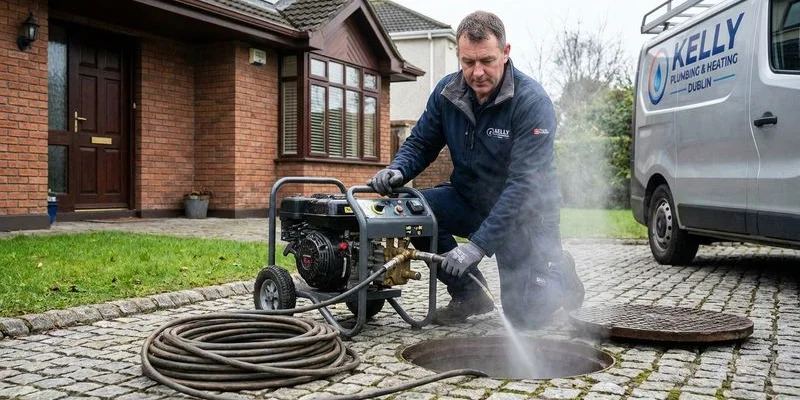
We use a specialist machine that pumps water through a reinforced hose at pressures between 2,000 and 4,000 PSI (pounds per square inch). For context, a standard garden hose operates at roughly 40-60 PSI.
The magic lies in the nozzle. It features one forward-facing jet to cut through debris and several rear-facing jets. These rear jets act like a rocket engine, propelling the hose 50+ metres down the pipe while scrubbing the pipe walls clean as we reel it back.
Advantages of drain jetting
- Total system clean: Jetting doesn’t just poke a hole in the blockage. It strips grease, scale, and silt from the pipe walls, returning the drain to near-new condition.
- Removes hard water scale: In areas of Sligo with hard water, limescale buildup constricts pipes over time. High-pressure water is the only non-chemical way to scour this rock-hard scale away.
- Long-range effectiveness: We can effectively clear blockages located 50 metres or more from the access point, far beyond the reach of manual rods.
- Cuts through roots: With a specialist cutting nozzle, jetting can slice through fibrous tree roots that have infiltrated the line.
Limitations of drain jetting
- Higher initial cost: Because it requires expensive machinery and fuel, jetting services in Ireland generally cost between €150 and €250+.
- Risk to fragile pipes: Older clay pipes or those with existing cracks can be damaged by 4,000 PSI of pressure if not managed carefully by an expert.
- Water supply needed: The machine requires a steady flow of water, usually from an outdoor tap or a hydrant.
- Access requirements: We need to get the heavy jetting unit relatively close to the manhole, which can be tricky in terraced houses with no rear access.
Head-to-Head Comparison
We have broken down the key differences to help you decide which method fits your current problem.
| Factor | Drain Rods | Drain Jetting |
|---|---|---|
| Typical Cost (Ireland) | €80 - €150 | €150 - €250+ |
| Primary Action | Puncture / Dislodge | Scour / Clean |
| Effectiveness on Grease | Poor (pushes it around) | Excellent (removes it) |
| Limescale Removal | None | High |
| Reach | 15-25 metres max | 50-100 metres |
| Risk to Old Pipes | Low | Moderate (requires skill) |
| Long-Term Result | Fixes immediate symptom | Prevents future issues |
Which Method Is Right for Your Situation?
Choose drain rods when:
- The blockage is in a toilet or sink pipe close to the house.
- You know the object is soft (like a roll of toilet paper or food waste).
- Your budget is tight and you need a simple flow restoration.
- You are dealing with a pre-1970s property where the pipe joints might be weak or loose.
To keep future blockages at bay, follow these practical tips on how to prevent blocked drains at home.
Choose drain jetting when:
- The blockage keeps coming back (a sign of grease or scale buildup on the walls).
- You hear gurgling noises from multiple drains, indicating a blockage deep in the main line.
- You suspect tree roots are involved.
- You have recently bought a house and want to “reset” the drainage system to ensure it is clean.
- Manual rodding has failed to clear the line.
The County Sligo Factor
Drainage issues in Sligo are often dictated by the specific geology and age of our local infrastructure.
Hard water impact: Parts of County Sligo have moderately hard water (rich in calcium carbonate). Over decades, this minerals deposits on the inside of drain pipes, creating rough surfaces that catch paper and waste. Rods cannot remove this scale. Our team finds that jetting is often necessary in these areas to restore the full diameter of the pipe.
Pipe materials by era:
- Pre-1970s (Clay Pipes): Many older Sligo townhouses rely on clay pipes with mortar joints. These are brittle. We always use lower pressure or specialized “flushing” nozzles here to avoid blowing out the joints.
- 1970s-1990s (Mixed): You might find a mix of clay and early PVC. These can suffer from “stepping,” where the ground settles and pipes misalign. Rods often hit these steps and stop dead, whereas a jetter hose can navigate the jump.
- Post-2000s (PVC): Modern plastic pipes are incredibly durable. They can withstand high-pressure jetting easily, making it the most efficient way to maintain them.
Weather patterns: Sligo’s heavy Atlantic rainfall puts immense pressure on surface water drains. We frequently see gullies packed with sand, silt, and autumn leaves. Rods simply push this sludge further down the line. Jetting is the only way to fluidize the silt and flush it completely out of the system.
Can You Do It Yourself?
Drain rods: You can buy a basic set of drain rods at a local hardware store for €30-€50. Homeowners can successfully clear simple blockages this way.
However, you must follow the golden rule: Always twist clockwise.
If you twist anti-clockwise while the rod is deep underground, it will unscrew. We attend many callouts where we have to retrieve a lost set of rods before we can even start on the blockage.
Drain jetting: This is strictly a professional task. Consumer pressure washers (like a Kärcher) are great for patios but lack the flow rate (litres per minute) to clear a 4-inch sewer pipe effectively.
Professional jetters operate at pressures that can cut skin and cause serious injection injuries. The risk of blowback—where sewage is blasted back up the toilet or out of the drain—is also high if you don’t know how to manage the pressure equalization.
Our Approach
We don’t believe in guessing with your home’s infrastructure. At Emergency Plumber Sligo, our vans are equipped with both heavy-duty rods and high-performance truck-mounted jetters.
We typically start with a quick assessment. If the blockage feels soft and close, we rod it to save you money. If we hit resistance or suspect a bigger issue, we deploy the jetter. For recurring issues, we use a CCTV camera to show you exactly what is happening underground.
This diagnostic-first approach prevents you from paying for expensive machinery when a simple rod would do, but ensures you have the heavy artillery ready if needed.
If you have a blocked drain in County Sligo, call us on 087 341 0745. We will have your drains flowing freely again as quickly as possible.
Need a Plumber in Sligo?
Our team is available 24/7 for emergency and scheduled plumbing services across County Sligo.