What to Do in a Plumbing Emergency: A Step-by-Step Guide for Sligo Homeowners
Burst pipe or major leak? Follow this step-by-step emergency guide to minimise damage while waiting for your plumber to arrive.
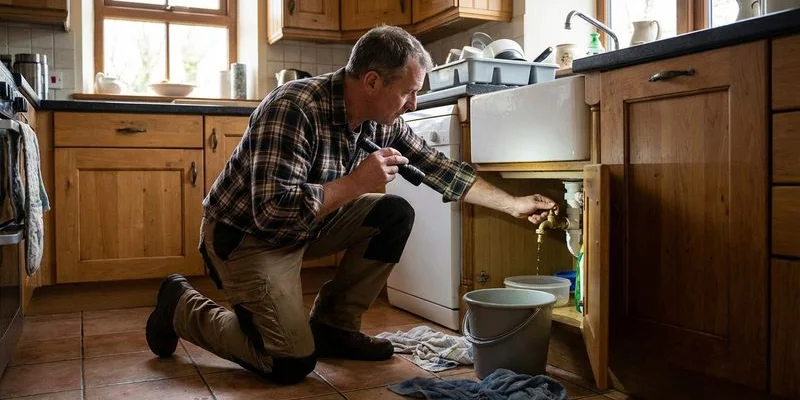
You know that sinking feeling when you hear running water where there shouldn’t be any. From what we see on the ground, panic is the biggest enemy in a plumbing emergency. It leads to wasted minutes, and in our line of work, minutes can equal thousands of euro in restoration costs.
In fact, recent data shows that “escape of water” (burst pipes and leaks) now accounts for 33% of all home insurance claims in Ireland. That makes it the single most common risk to your property, even ahead of fire or storm damage.
We have attended countless emergencies across County Sligo, from flooded apartments in Sligo Town to frozen farmhouse pipes in the Ox Mountains. Through this experience, we have developed a precise protocol to minimize damage. This guide outlines the exact steps you need to take the moment you spot trouble.
Step 1: Turn Off the Water Supply
Your immediate priority is to stop the flow of water. Every second the mains supply remains open, gallons of water are pouring into your home.
The Internal Stopcock
For most homes in Sligo, you will find this valve under the kitchen sink. It usually looks like a brass tap or a small wheel. Turn it clockwise until it stops. If you’re unsure about the location in your property, check out our guide on where is the stopcock in my house.
If you cannot find it under the sink, check these common locations:
- The Hot Press: Look near the bottom of the cylinder in the airing cupboard.
- The Utility Room: Often located where the pipework enters the rear of the house.
- The Hallway: In older terraced properties, it is sometimes found near the front door.
Pro Tip: If the valve is seized (stiff) from lack of use, do not force it with a wrench, as you might snap the spindle. Try to loosen it gently with a pair of pliers, using a cloth to protect the metal. If it won’t budge, move immediately to the external stopcock.
The External Stopcock
This is your backup plan. It is located outside your property boundary, usually on the footpath or just inside your driveway, under a small plastic or metal cover (often marked “Uisce” or “Water”).
You may need a universal stopcock key (often called a “crutch key” in Ireland) to turn this, as the valve can be deep underground. We recommend every homeowner buys one of these from a local hardware provider like Brooks or Chadwicks to keep for emergencies.
Step 2: Shut Down Your Heating Systems
Once the water is off, you must protect your heating equipment. If your boiler continues to fire while the system loses pressure, it can cause severe mechanical damage or an airlock that is difficult to clear.
Turn off your boiler immediately at the main programmer or the isolation switch (usually a white switch with a red neon light nearby).
Specific Advice for Oil Boiler Owners: Oil heating is standard for many of our rural customers in Tubbercurry and Enniscrone. If you suspect the leak is coming from the boiler unit itself, locate the oil isolation valve. This is usually a small red handwheel or lever on the oil line before it enters the boiler house. shutting this off prevents fuel wastage and environmental damage.
Step 3: Assess the Electrical Risk
Water and electricity are a potentially lethal combination. Before you step into any puddle, look up and look around.
If water is dripping near light fittings, switches, or sockets, you must cut the power. Go to your consumer unit (fuse board) and trip the main switch to “OFF.”
Safety Warning: If the fuse board itself is wet, or if you are standing in water, do not touch anything electrical. Call ESB Networks immediately on 1800 372 999. Their emergency crews are trained to make the area safe before any plumbing work begins.
Step 4: Drain the Pipes
Turning off the stopcock stops new water from entering, but your pipes are still full of water waiting to leak out. You need to empty them in a controlled way.
Follow this sequence to drain the system efficiently:
- Open the cold taps in the bath and sinks (this drains the attic tank).
- Flush all toilets to empty the cisterns.
- Open the hot taps to drain the hot water cylinder.
We recommend catching this water in buckets if you can, but the priority is to get it out of the pipes so it doesn’t end up on your floor.
Step 5: Containment and Damage Limitation
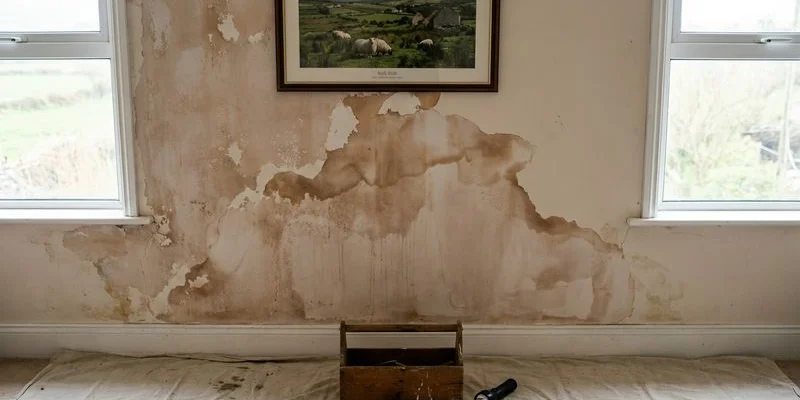
Now that the flow has stopped, your focus shifts to saving your property. Water can destroy flooring and plasterboard incredibly fast.
Crucial “Insider” Tip for Ceiling Leaks: If you see a bulge forming in your ceiling, the plasterboard is holding a large weight of water and could collapse. Take a screwdriver or a sharp object and poke a small hole right in the centre of the bulge. Place a bucket underneath to catch the stream. This simple action relieves the pressure and often saves the entire ceiling from coming down.
Managing Humidity and Mould
In the damp Sligo climate, mould growth can begin within 24 to 48 hours if relative humidity stays above 60%.
Start the drying process immediately:
- Open windows to create a cross-breeze.
- Lift wet rugs and move furniture to dry areas.
- If you have a dehumidifier, turn it on at the highest setting.
Step 6: Document Everything for Insurance
Most Irish home insurance policies cover “escape of water,” but the burden of proof is on you. Do not throw away damaged items immediately.
Take clear, high-quality photos and videos of:
- The source of the leak (if visible).
- The standing water depth.
- Any damaged goods (soaked carpets, warped wood, ruined electronics).
The Golden Rule: Keep the damaged parts. If we replace a split copper pipe or a corroded valve, ask us to leave the old part with you. Your insurance assessor may want to see the physical evidence to confirm the cause of the failure.
Step 7: Call an Emergency Plumber
With the situation stabilized, it is time to bring in the professionals. When you contact us or any emergency service, clear information helps us reach you faster.
Please have the following ready:
- Your Eircode: This is vital for us to find rural properties in the dark.
- The nature of the leak: Is it a “gushing” mains pipe or a dripping tank?
- System details: Do you have a gas or oil boiler? Is it a pressurized system?
In Sligo, you can expect to pay an emergency call-out fee ranging from €120 to €150 (excluding VAT and parts) for after-hours service. This typically covers the first hour of labour to diagnose and make the system safe.
Unique Plumbing Challenges in County Sligo
Every region has its own quirks, and Sligo is no different. We encounter specific issues here that homeowners should be aware of.
The “Gunbarrel” Pipe Problem
Many bungalows built in Sligo during the 1970s and 80s were fitted with “Gunbarrel” (steel) heating pipes. These pipes rust from the inside out. If you have this system, a leak in one area is often a warning sign that the entire system is degrading. We strongly advise replacing these sections rather than just patching them.
Hard vs. Soft Water Zones
Your location in the county dictates your risk of limescale.
- Riverstown and South Sligo: You likely have hard water (approx. 320 mg/l). This causes limescale buildup in boilers and kettles, leading to overheating and leaks.
- Sligo Town and North Sligo: If you are on the Lough Gill supply, you have softer water (approx. 110 mg/l), which is kinder to appliances but can be more corrosive to certain older pipe metals.
Prevention: The Smart Investment
You can avoid the stress of an emergency with a few proactive steps.
| Prevention Task | Why It Matters | Frequency |
|---|---|---|
| Service Your Boiler | Prevents winter breakdowns and carbon monoxide risks. | Annually |
| Check Stopcocks | Ensures you can turn water off quickly in a crisis. | Every 6 Months |
| Insulate Attic Pipes | Stops freezing during cold Atlantic storms. | Once (Check yearly) |
| Bleed Radiators | Releases trapped air to reduce system corrosion. | Autumn |
Grant Aid Opportunity: If you are upgrading an older heating system, check the SEAI (Sustainable Energy Authority of Ireland) website. There are grants available for heating control upgrades that could help subsidize the cost of replacing old, vulnerable valves and pipework.
We Are Here When You Need Us
A plumbing emergency is stressful, but you don’t have to handle it alone. We pride ourselves on rapid response times and clear, honest communication.
Call us on 087 341 0745 day or night. We will help you secure your home, fix the problem, and get your water running again.
Need a Plumber in Sligo?
Our team is available 24/7 for emergency and scheduled plumbing services across County Sligo.