When to Replace Your Attic Water Tank: Signs and What to Expect
Old or leaking attic water tank? Learn the warning signs that your cold water storage tank needs replacing and what the replacement involves.
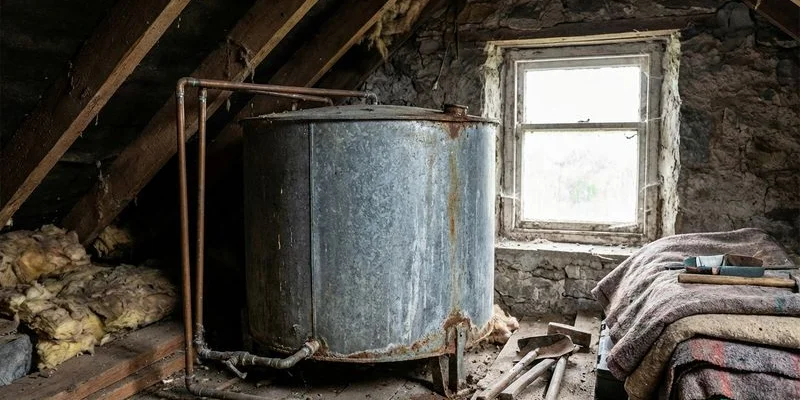
Most homeowners in County Sligo rarely think about the large tank sitting above their heads. You might only notice it when the shower pressure drops or a strange noise echoes from the ceiling.
This cold water storage tank is the heart of a gravity-fed system. It silently feeds your bathroom taps, toilet cisterns, and hot water cylinder day after day.
But these tanks have a finite lifespan.
From our experience attending calls across the county, we know that when a tank fails, it rarely happens at a convenient time. The damage to ceilings, carpets, and electrics can be substantial.
We want to help you spot the problems before they turn into a disaster. Here is the practical data and advice you need to decide if it is time for a replacement.
What Is an Attic Water Tank?
The attic water tank acts as a buffer for your home’s water supply. It sits at the highest point of the property to create pressure using gravity.
In the plumbing trade, we call this a cold water storage cistern. It connects to the mains supply via a ball valve. This valve opens to refill the tank automatically whenever you draw water for a bath or flush the toilet.
Standard Irish gravity-fed systems rely on this tank for:
- Bathroom cold taps: Your basin, bath, and standard mixer showers.
- Toilet cisterns: Refilling the toilet after use.
- Hot water cylinder: Providing the cold water that your boiler or immersion heater eventually warms up.
Your kitchen cold tap is the exception. It usually runs directly off the mains pipe (rising main). That is why the kitchen tap often blasts water out while the upstairs bathroom tap flows more gently.
Common Tank Materials
Identifying your tank type is the first step in assessing risk.
- Galvanised Steel (High Risk): If your home was built between the 1950s and early 1980s, you likely have one of these. They are large, rectangular metal tanks. Insider Tip: If you still have a galvanised tank in 2026, it is statistically working on borrowed time. The zinc coating has likely worn away, leaving the steel exposed to rust.
- Plastic/Polyethylene (Standard): These became the norm in the mid-1980s. They are usually black or grey circular cisterns. Modern versions from brands like Kingspan or Titan are rigid and robust. However, early black plastic tanks from the 80s can become brittle and crack (a defect known as crazing).
- GRP (Fibreglass): You see these in larger homes or commercial buildings. They consist of sectional panels bolted together. They are incredibly durable but expensive to install.
Warning Signs Your Tank Needs Replacing
You do not need to be a plumber to spot the red flags. We recommend popping your head into the attic once a year with a torch to check these specific indicators.
1. Rust-Coloured Water
Turn on your bathroom hot tap. If the water runs clear, you are okay. If it runs brown or orange, but your kitchen cold tap is clear, the issue is internal.
This usually means a galvanised attic tank is rusting from the inside out. The zinc protection has failed. The steel is now corroding and sending iron oxide particles down your pipes.
This sediment damages ceramic discs in modern taps and clogs shower heads. It is a clear signal that the tank walls are thinning and a breach is imminent.
2. External Corrosion and White Deposits
When you inspect a metal tank, look for “weeping” joints.
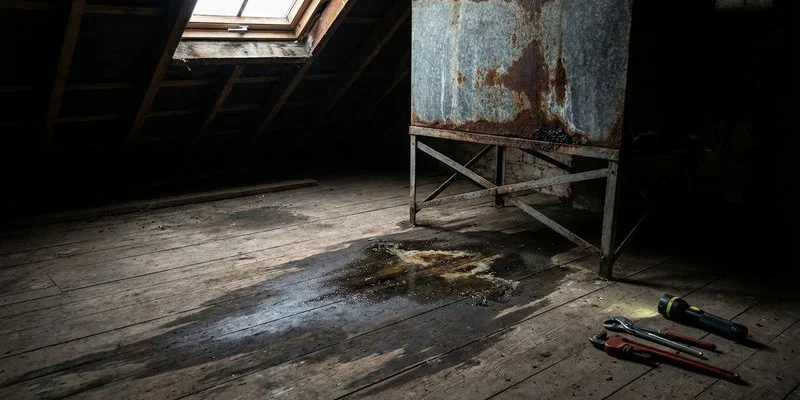
Small white crusty deposits (limescale and salts) on the outside of the tank indicate a pinhole leak. The water evaporates before it hits the floor, leaving the mineral deposit behind.
What to look for:
- Rust patches along the bottom seams.
- White trails running down the side of the tank.
- Damp patches on the timber platform supporting the tank.
If you see these signs on a steel tank, do not attempt to patch it. The metal around the leak is likely paper-thin.
3. Active Leaks
A dripping tank is an emergency. Water is relentless.
A slow drip will saturate your insulation, rendering it useless. It then soaks into the plasterboard ceiling below. Wet plasterboard loses its strength and can eventually collapse under its own weight.
Insurance Warning: Many Irish home insurance policies have strict clauses regarding “gradual damage.” If a tank leaks slowly over months because of age and lack of maintenance, your insurer may refuse the claim. They often cover “sudden and accidental” damage only.
4. Sludge and Hygiene Issues
Modern regulations require tanks to be tightly covered. Older tanks often have loose lids or no lids at all.
We frequently find open tanks containing:
- Dead insects and spiders.
- Bird droppings (if the roof felt is damaged).
- Thick layers of sludge at the bottom.
This bacteria-rich water is feeding your shower. While you don’t drink it, you are inhaling the mist.
The Legionella Risk: Sediment provides nutrients for Legionella bacteria. If your attic gets warm in the summer (above 20°C) and the water sits stagnant, it becomes a breeding ground. A new, sterile plastic tank with a tight-fitting lid is the best defence against this.
5. Lack of Insulation
A tank without a “jacket” is a liability in Sligo winters.
If your tank is just a bare metal or plastic shell, it is prone to freezing. When water freezes, it expands. This expansion can split plastic and burst metal seams.
Modern tanks come with insulation jackets or are pre-insulated to protect against temperatures dropping below zero.
6. Constant Overflowing
If you hear a continuous dripping sound outside your house or see water running from a pipe under the roof eaves, your ball valve has failed.
While we can replace just the valve, we often advise against it on very old tanks. The physical stress of wrenching off a rusted valve can sometimes crack an old tank connection. It is often safer to upgrade the whole unit.
What Does Replacing an Attic Tank Involve?
This is a significant job that involves working in a confined space. We handle the logistics so you don’t have to worry about ceiling damage.
The Replacement Process
- Isolation: We shut off the mains water and drain the system completely.
- Removal: Getting a large galvanised tank out of a small attic hatch is the hardest part. We often have to cut the old metal tank into sections using a reciprocating saw to remove it safely.
- Support Check: A 50-gallon tank weighs over 250kg when full. We ensure the timber platform is solid and spans the joists correctly.
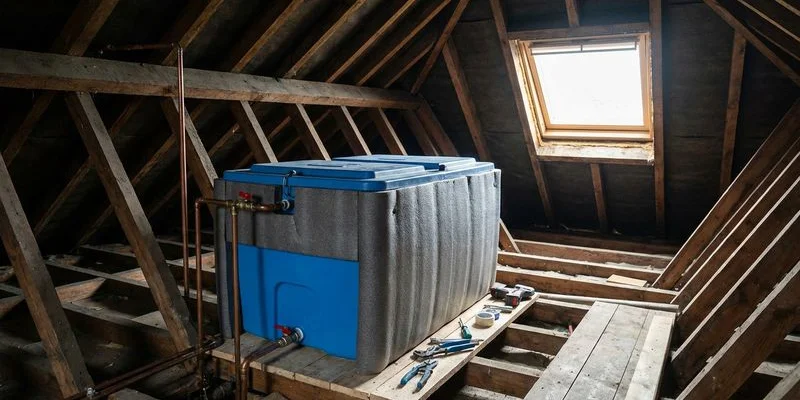
- Installation: We bring up a new, flexible plastic tank. These are designed to deform slightly to squeeze through standard attic trapdoors.
- Connection: We reconnect the feeds using compression fittings. We also install a new overflow pipe with a screen to stop insects entering.
- Protection: We fit the “By-law 30” kit (a specific set of fittings including a backing plate) to prevent the valve twisting. We then secure the lid and insulation jacket.
Tank Size Standards
For a standard 3-4 bedroom home in Sligo, we typically install a 50-gallon (227-litre) tank.
Larger homes with multiple bathrooms might require a 100-gallon version. We size this based on your peak usage to ensure you don’t run out of water during the morning rush.
How Much Does It Cost? (2025/2026 Estimates)
Prices have risen slightly due to material costs, but a tank replacement remains a high-value investment compared to the cost of water damage.
Here is the typical pricing for a professional installation in the Sligo region:
| Item | Estimated Cost |
|---|---|
| New 50-gallon Plastic Tank | €60 - €100 |
| High-Quality Ball Valve & Fittings | €35 - €55 |
| Insulation Jacket & Lid | €25 - €40 |
| Labour (Removal & Install) | €250 - €400 |
| Disposal of Old Tank | Included in labour |
| Total Estimated Cost | €370 - €595 |
Note: These prices assume standard access. If we need to rebuild the timber support base or replace extensive sections of corroded pipework, the cost may be higher.
Gravity vs. Unvented: Should You Upgrade?
You might be considering getting rid of the tank entirely.
This involves switching to an unvented system. This system feeds your hot water cylinder directly from the mains, eliminating the need for cold water storage in the attic.
Comparison: Gravity Tank vs. Unvented System
| Feature | Standard Gravity Tank (Replacement) | Unvented System (Upgrade) |
|---|---|---|
| Water Pressure | Low (0.2 - 0.5 bar typically) | High (Mains pressure) |
| Shower Performance | Needs a pump for power showers | Excellent without pumps |
| Installation Cost | Low (€370 - €600) | High (€2,000 - €3,500+) |
| Maintenance | Low | Annual safety check required |
| Noise | Silent refilling | Can be noisier |
The Sligo Water Pressure Factor: Unvented systems require consistent high mains pressure (usually 1.5 bar constant). Some rural areas in Sligo suffer from pressure fluctuations. If your mains pressure is weak, an unvented system will not work without expensive accumulator pumps.
For most homeowners, a direct swap to a modern plastic tank is the most cost-effective and reliable solution.
Do Not Wait for a Failure
We cannot stress this enough: Galvanised tanks do not heal. They only get worse.
We have seen the aftermath of a burst tank. It involves weeks of industrial dehumidifiers, ruined family heirlooms, and the hassle of moving out while ceilings are replaced.
If your tank is metal and older than 30 years, it is living on borrowed time.
At Emergency Plumber Sligo, we specialize in these replacements. We treat your home with respect, remove the old hazardous metal safely, and install a modern, hygienic system that will last for decades.
Call us on 087 341 0745 to book an inspection or replacement. We can usually give you a clear quote over the phone if you can send us a photo of your current setup.
Need a Plumber in Sligo?
Our team is available 24/7 for emergency and scheduled plumbing services across County Sligo.