Where Is the Stopcock in My House? How to Find and Use Your Mains Water Shut-Off
Every homeowner should know where their stopcock is. Learn how to find your mains water shut-off valve and how to use it in an emergency.
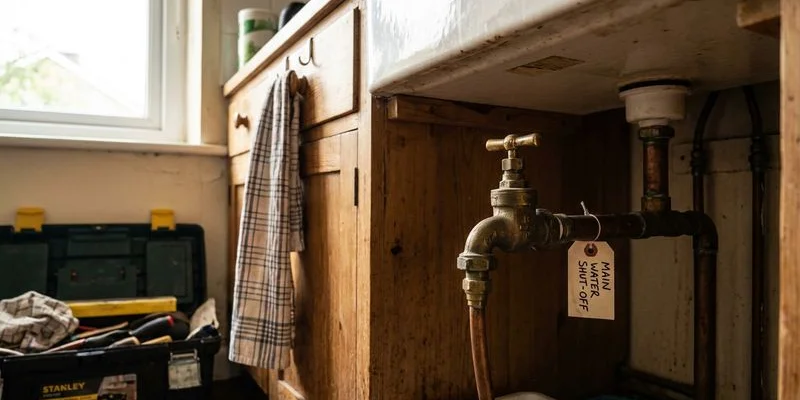
It’s the question that catches more homeowners off guard than you might expect: where is the stopcock in my house?
In a plumbing emergency—a burst pipe, a major leak, or an overflowing tank—knowing the exact location of your mains water shut-off valve is critical. Being able to turn it off in seconds can be the difference between a quick mop-up job and thousands of Euro in structural water damage.
Yet we regularly attend emergencies across County Sligo where the homeowner has no idea where their stopcock is located.
Often, they cannot find it in the panic or discover that it is seized shut because it has not been turned for years.
This guide will help you locate your stopcock, understand how to operate it, and ensure it is ready for action when you need it most.
What Is a Stopcock?
A stopcock is the primary valve that controls the flow of mains water into your home. When fully open, water flows freely from the public mains supply through your internal plumbing. When closed (turned fully clockwise), it completely shuts off the water supply to the property.
The stopcock typically looks like a brass tap or valve handle and sits on the mains water supply pipe where it enters your home. In Ireland, this pipe is usually a 15mm or 22mm copper or plastic pipe (or 1/2 inch to 3/4 inch in older properties).
Important: The stopcock only controls the mains water supply. In a gravity-fed system (which many Sligo homes still use), closing the stopcock stops water from entering the attic cold water storage tank. However, the tank itself and the pipes it feeds will still contain water. To fully drain the system, you must close the stopcock AND open your cold taps until they run dry.
The Two Main Types of Stopcocks
You will likely encounter one of two types of valves in your home. Knowing the difference helps you use them correctly.
| Feature | Brass Gate Valve (Traditional) | Lever Valve (Modern) |
|---|---|---|
| Appearance | Round brass “crutch” head or wheel handle. | A flat yellow, blue, or red lever handle. |
| Operation | Requires multiple turns to close. | Requires just a quarter-turn (90 degrees). |
| Reliability | Prone to seizing if not used regularly. | Rarely seizes; much easier to operate. |
| Common Use | Found in most pre-2010 Irish homes. | Standard in new builds and renovations. |
Where to Find the Internal Stopcock
In most Irish homes, the internal stopcock is in one of a few specific locations.
Under the kitchen sink
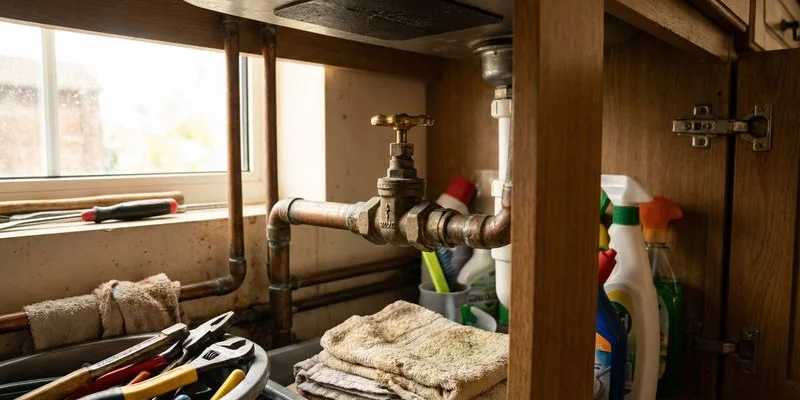
This is the most common location by far. Open the cupboard beneath the kitchen sink and look for a tap handle on the incoming water pipe. It is usually on the right-hand side as you face the cupboard, close to where the pipe comes up through the floor or through the wall.
In a utility room
If your home has a utility room or scullery (common in older Sligo properties), the stopcock may be located there. This is particularly likely if the mains supply enters the house through the utility room wall rather than the kitchen.
In a downstairs WC or cloakroom
Some properties, especially newer builds from the last 20 years, have the stopcock in a ground-floor cloakroom or WC near the front of the house. Look for a small access panel or check inside the vanity unit.
Under the stairs
In some terraced and semi-detached houses, the stopcock is located in the cupboard under the stairs. It will be near where the mains supply enters through the front wall.
In a hallway or porch
Occasionally, the stopcock is mounted on the wall in a ground-floor hallway. This is found in older properties where the original plumbing layout placed the mains entry at the very front of the house.
In a garage or outbuilding
In some rural Sligo properties, particularly older farmhouses, the mains supply may enter through a garage or adjacent outbuilding before running underground to the main house. The stopcock may be located in this outbuilding, often near the door.
Pro Tip: The “Surestop” Upgrade
If your stopcock is in a difficult spot, consider installing a Surestop switch. This is a remote switch (costing around €80-€100 for the part) that uses water pressure to turn off your mains with a simple button press. We often install these on the kitchen wall or inside a reachable cupboard for elderly clients or those with limited mobility.
How to Use the Stopcock
Turning off the water
Turn the stopcock handle clockwise (to the right) to shut off the water supply. Keep turning until you feel resistance, but stop immediately once it feels closed. Do not force it tight, as this can jam the valve.
Turning on the water
Turn the handle anticlockwise (to the left) to restore the water supply. Open it fully until it stops.
Crucial Step: Once fully open, turn the handle back one-quarter turn clockwise. This small back-turn prevents the valve spindle from sticking in the fully open position, which is the number one cause of seized valves.
If the stopcock is stiff or seized
This is extremely common in older homes where the stopcock has not been turned for years. Do not force it with a wrench or pliers immediately, as you risk snapping the brass head or twisting the copper pipe.
To free a stiff stopcock:
- Apply a penetrating oil (like WD-40 Specialist or PlusGas) around the spindle where it enters the valve body.
- Leave it for at least an hour, preferably overnight, to let the oil work into the threads.
- Try turning it gently with a pair of pliers (protect the valve head with a cloth).
- Turn it just a fraction in each direction (tighten then loosen), working it gradually.
- Apply more penetrating oil and repeat the process over several days if necessary.
If the stopcock will not budge despite your best efforts, it needs replacing. This is a job for a plumber and typically costs between €150 and €250 depending on accessibility, but it is well worth doing proactively.
The External Stopcock
In addition to the internal stopcock, there is usually an external stopcock at the boundary of your property. This is typically near the front gate or footpath.
How to find it
Look for a small round or rectangular metal or plastic cover set into the ground. It is often marked “WATER”, “UISCE”, or with a “W”. In rural County Sligo, it might be:
- Set into the grass verge near the road.
- In the driveway near the entrance.
- Near the front wall of the property.
- Hidden under soil, grass, or gravel (years of neglect can bury them).
How to use it
The external stopcock sits at the bottom of a narrow chamber (typically 450mm-750mm deep). You will need a stopcock key (a long T-shaped metal tool) to reach down and turn the valve. You can buy these at hardware stores like Woodie’s or Chadwicks for around €12-€18.
Turn the key clockwise to shut off the supply. Note that this shuts off water to the pipe feeding your property, so it stops water reaching your internal stopcock and everything inside.
Understanding Responsibility: You vs. Uisce Éireann
It is important to know where your liability ends.
- Uisce Éireann (Irish Water) is responsible for the mains network and the pipe up to the boundary of your property (usually including the external stopcock).
- You (The Homeowner) are generally responsible for the supply pipe from the property boundary into your home and all internal plumbing.
If you cannot find your external stopcock or it is broken, contact Uisce Éireann. However, if the leak is on the pipe running from the stopcock to your house, you will likely need a private plumber to fix it.
Isolation Valves: Your Second Line of Defence
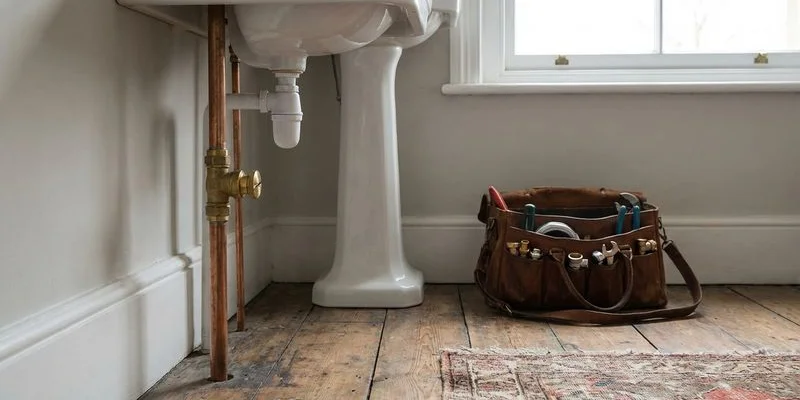
In addition to the main stopcock, modern plumbing installations include isolation valves (often called service valves) on individual fixtures. These allow you to shut off the water to a specific tap or appliance without cutting off the whole house.
Look for small chrome valves with a slotted screw head on the pipes beneath:
- Kitchen and bathroom taps.
- Toilet cistern supply.
- Washing machine and dishwasher connections.
- Boiler cold water feed.
- Hot water cylinder feed.
Knowing where these isolation valves are is incredibly useful. If a single tap is leaking or a toilet is overflowing, you can isolate just that fixture while keeping water flowing to the rest of the house. You simply use a flathead screwdriver to turn the slot 90 degrees so it is across the pipe (off) rather than in line with it (on).
The Stopcock Maintenance Checklist
Your stopcock needs occasional attention to ensure it works when you need it most:
- Exercise the valve twice a year: We recommend turning your stopcock off and on again every six months (perhaps when the clocks change). This prevents scale from locking the mechanism.
- Check for “weeping” leaks: Look for dampness or green staining around the valve spindle. A leaking stopcock gland is a common issue that can rot kitchen cabinets over time.
- Label it clearly: If the stopcock is hidden in a dark cupboard, stick a bright label or tag on it so anyone in the household can find it quickly in an emergency.
- Brief the household: Make sure your partner, older children, and any house-sitters know the location. You might not be the one home when a pipe bursts.
- Keep the area clear: Do not stack boxes, cleaning products, or other items in front of the stopcock. You need instant, unobstructed access in a crisis.
Common Stopcock Problems in Sligo Homes
Based on our experience across County Sligo, the most common stopcock issues we encounter include:
Seized stopcocks
This is by far the most common problem. Stopcocks that have not been turned for 10, 20, or 30+ years often seize completely. We regularly replace these with modern lever valves, which are much less likely to stick.
Stopcocks in the wrong location
In some older properties, the stopcock is in an illogical location due to past modifications—sometimes found inside a wall, behind a fitted kitchen unit, or buried under a concrete floor. In these cases, we can install a new stopcock in a more accessible position.
”Gunbarrel” or Lead Piping Issues
In Sligo homes built before the 1970s, the stopcock may be connected to old iron “gunbarrel” or lead pipes. These materials can become brittle or blocked with rust over time. If you see grey, soft lead pipework entering your stopcock, we strongly advise having it assessed for replacement due to health and leak risks.
Missing stopcocks
Surprisingly, some homes (particularly very old rural properties) do not have an accessible internal stopcock at all. The mains supply runs straight to the attic tank with no shut-off point. This is dangerous in an emergency and should be rectified immediately by fitting a valve on the incoming supply.
Every Second Counts in an Emergency
When a pipe bursts, a tank overflows, or a fitting fails, the amount of water damage depends entirely on how quickly you can stop the flow.
Knowing where your stopcock is—and being confident it will turn—can save you from thousands of Euro in repairs and months of disruption.
Take five minutes today to find your stopcock, check that it turns freely, and show your household where it is. It is one of the simplest and most valuable things you can do for your home’s security.
If your stopcock is seized, missing, or in a difficult location, Emergency Plumber Sligo can replace or relocate it for you. We serve the whole of County Sligo and can have your water supply properly controlled and protected.
Call us on 087 341 0745 for stopcock replacement, plumbing advice, or any emergency plumbing need.
Need a Plumber in Sligo?
Our team is available 24/7 for emergency and scheduled plumbing services across County Sligo.